
When divorcing spouses need to sell the family home, skipping the realtor can save $22,500 or more in commissions, close in as few as 7-14 days, and keep the entire transaction out of the MLS — no open houses, no strangers walking through, no public record of your situation. In California, selling directly to a cash buyer is completely legal and increasingly common among divorcing homeowners who need speed, simplicity, and privacy more than a maximized list price.
The Marital Home Feels Like One More Battle You Did Not Sign Up For
You are already dealing with attorneys, court dates, custody arrangements, and the emotional weight of ending a marriage. The house should be the easy part. It rarely is.
One of you wants to sell quickly and move on. The other is not sure. You disagree on price. You disagree on who handles the repairs. You are both watching the calendar and the bank account simultaneously.
Then someone suggests hiring a real estate agent.
Now you have a third party in the middle of an already complicated situation — someone who needs both of you to agree on repairs, staging, showing schedules, price reductions, and counteroffers. Every decision that requires both signatures becomes a potential sticking point. And in California, where a traditional home sale takes 45 to 90 days from listing to close, that is a long time to remain financially and legally entangled with someone you are trying to separate from.
There is a different way to handle this. And a growing number of divorcing homeowners in Sacramento, Elk Grove, Roseville, and across the region are choosing it.
Why a Realtor Complicates a Divorce Sale
A listing agent is optimized for one outcome: the highest possible sale price after the longest reasonable time on the market. That works well when the sellers are aligned, patient, and motivated by top dollar.
Divorcing homeowners usually need something different.
Here is what the traditional listing process actually requires of you:
- Joint decision-making at every stage — repairs, price, counteroffers, accepted contingencies
- Physical access to the home for showings, inspections, appraisals, and walk-throughs
- Shared responsibility for costs — staging ($3,000-$5,000), pre-sale repairs ($10,000-$40,000+), and holding costs ($1,500-$3,000/month in mortgage, taxes, and insurance)
- Agent commission of 5-6% at closing — on a $460,000 Sacramento area home, that is $23,000-$27,600 off the top, split before either spouse sees a dollar
- Time — the average Sacramento listing takes 30-60 days to go under contract, then another 30-45 days to close, and roughly 25% of traditional sales in California fall through before the finish line
That last point matters more than most people realize. If your sale falls through at the 60-day mark, you restart the clock. You are still co-owners. You are still paying for the house together. Your divorce settlement may be delayed because the asset has not been liquidated.
For many divorcing couples, the agent route is not slower by a few weeks. It is slower by months — with more friction, more joint decisions, and more shared exposure at exactly the moment you are trying to create separation.
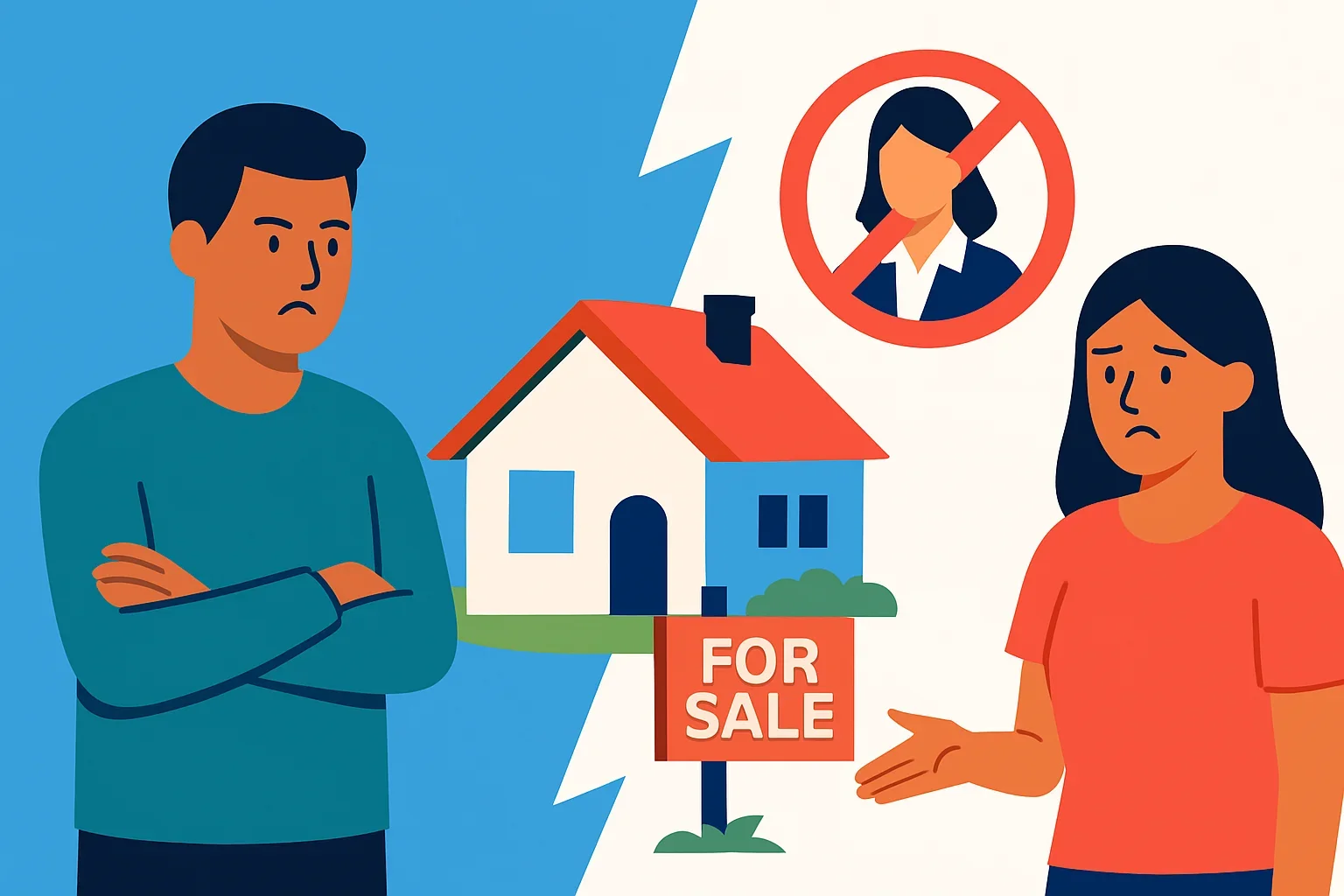
What Are Your Options Without a Realtor?
When you want to avoid using a realtor in a divorce sale, you have three realistic paths:
Option 1: FSBO (For Sale By Owner)
You list and manage the sale yourselves, without an agent. You keep the commission but take on all the work: pricing, marketing, showings, negotiations, contracts, and disclosures.
The catch in a divorce context: FSBO requires the most coordination between the two of you. Every step involves decisions both parties have to make together. If communication is strained — and in most divorces, it is — FSBO becomes the hardest option, not the easiest. You can learn more about the practical mechanics of selling a home without a realtor before deciding whether this path fits your situation.
Option 2: Auction
An auction can move fast, but it often produces below-market results with no price floor guarantee. It also requires both parties to agree on terms and timeline. Not ideal when one spouse is reluctant.
Option 3: Direct Sale to a Cash Buyer
You sell directly to a real estate investment company or local cash buyer. No listing, no showings, no agent, no commission. The buyer makes an offer, you accept, and a licensed title company handles the closing.
This is the option that eliminates most of the coordination burden. One offer. One decision. One closing date you both agree to. Done.
Comparing Your Options: The Real Numbers
| Traditional Listing | FSBO | Cash Sale | |
|---|---|---|---|
| Agent commission | 5-6% ($23,000+) | $0 | $0 |
| Pre-sale repairs | $10,000-$40,000 | $10,000-$40,000 | $0 |
| Staging costs | $3,000-$5,000 | $1,000-$3,000 | $0 |
| Holding costs (3 months) | $4,500-$9,000 | $4,500-$9,000 | Minimal |
| Time to close | 60-120 days | 60-90 days | 7-30 days |
| Joint decisions required | Many | Many | One (accept or decline) |
| MLS listing (public) | Yes | Yes | No |
| Typical net proceeds (on $460K home) | $380,000-$415,000 | $395,000-$420,000 | $370,000-$400,000 |
Key takeaway: The gap between a cash sale and a traditional listing is often much smaller than it looks once you subtract commissions, repairs, holding costs, and the cost of deals falling through. Many divorcing homeowners net a comparable amount — without the months of joint management.
The math changes further when there is disagreement between spouses. Every week of delay is another $1,500-$3,000 in shared housing costs on a property neither party may want to be paying for.
What If One Spouse Doesn't Want to Sell?
This is the most common scenario and the one that causes the most delay.
In California, if both names are on the deed, both signatures are required to sell. If one party refuses, the other can file a partition action in court — a legal process that forces the sale. This typically takes 6-12 months and costs both parties thousands in legal fees.
A faster path: a cash sale where the proceeds are cleanly split according to the divorce settlement. When the reluctant spouse sees the actual net numbers — including what the alternative (partition action, long listing, legal fees) actually costs — many reconsider. The comparison table above is useful for that kitchen table conversation.
If a divorce decree has already ordered the sale, a reputable cash buyer can work on the court's timeline, closing on the date the decree specifies. The decree itself provides authority to proceed even when communication between spouses is difficult.
Does a Cash Sale Protect Both Spouses Legally?
Yes — and this is important for both parties to understand.
A direct sale to a cash buyer uses the same legal framework as any California real estate transaction. Both parties review and sign a standard California purchase agreement. A neutral, licensed title company holds all funds in escrow, conducts a full title search, pays off any liens or the existing mortgage from proceeds, and wires the remaining balance to each party according to the agreed split.
Neither spouse touches the money directly. Neither spouse can accelerate or delay the disbursement without the other's consent. The title company is the neutral third party that protects both of you.
California also requires a Transfer Disclosure Statement (TDS) even in a direct cash sale. Disclose everything you know about the property's condition. A cash buyer expects issues — that is built into the offer. Honest disclosure protects you legally after the sale is complete.
If the home has a mortgage, it gets paid off at closing from the sale proceeds through the title company. You do not need to pay it off first. Many sellers are surprised to learn this — the mortgage is settled as part of the transaction, just like it would be in any other sale.

One More Thing Most Sellers Never Consider: Privacy
When you list a home on the MLS, your address, photos, and sale history become public record. In a divorce, that means neighbors, coworkers, mutual friends — anyone — can see that the home is for sale and draw their own conclusions.
A direct cash sale is entirely private. No sign in the yard. No Zillow listing. No open house. No one has to know the house is being sold until it is already done.
For families with children, for people in professional roles, or for anyone who simply wants to move forward without their personal circumstances becoming neighborhood conversation, the privacy of a direct sale is worth as much as the speed.
The California foreclosure process documentation from the Consumer Financial Protection Bureau is a useful reference if financial distress is also a factor — but in most divorce sales, the priority is simply eliminating friction and moving forward.
How the Process Works When You Go Direct
Many homeowners assume a cash buyer needs to visit the property before making an offer. That is not how Ummah Homes operates.
Everything starts with a phone call. No walkthroughs, no strangers in your home, no coordinating schedules between two spouses and a buyer's agent. Here is the exact sequence:
1. Fill out the form or call us
Takes about 2 minutes. Share your property address and basic details about the home.
2. Phone conversation
We gather the information we need to build an accurate offer — size, condition, any known issues, your timeline. Both parties can be on the call together or separately.
3. Cash offer, presented over the phone
No obligation. No pressure. You hear a number and you decide whether it works for your situation. If it does not, you simply say no. There is no awkward follow-up.
4. Sign the agreement
Standard California purchase agreement. Have your divorce attorney review it before signing if you want — that is completely reasonable and we encourage it.
5. We visit the property to confirm
After the agreement is signed, we schedule a brief visit to confirm that the property matches what was described. If everything checks out, the price stays exactly as offered. The only time an offer adjusts is if there is something neither party was aware of — a structural issue behind a wall, for example.
6. Close on your timeline
Average close: 21-24 days. But you choose the date. If you need 10 days, we can do 10 days. If you need 45 days while the divorce is finalized, we can work with that too.
Proceeds are wired within 24-48 hours of closing. Each spouse receives their share according to the agreement or decree. Clean, documented, final.
You do not need to clean or stage the home. You do not need to coordinate repairs. Leave whatever you do not want — furniture, personal items, anything left behind. Ummah Homes handles the cleanout after closing.
What Happens If the Numbers Do Not Work?
The offer is just a starting point for a conversation. If the number does not work for one or both spouses, you say no. No penalty, no pressure, no obligation. We give you a number, you decide — that is the entire commitment at that stage.
If something changes after you have said yes — a new development in the divorce proceedings, a question about the timeline — reach out and we will work through it. Hundreds of homeowners across the Sacramento region have navigated complicated sales with Ummah Homes, including divorces, inherited properties, and situations involving liens or financial distress. Flexibility is part of the process.
If you are still weighing your options, understanding the real costs of selling your house in Sacramento is a useful next step — the full breakdown of commissions, repairs, and carrying costs often changes how the numbers look.
When you are ready to see what your home could sell for — no obligation, no commitment, just a number — fill out the short form below. We will call you within 24 hours.
"*" indicates required fields
What Happens After You Submit
- We call within 24 hours to learn about your property and situation over the phone
- Second call to walk you through the process, confirm timeline, and present a fair cash offer — no pressure, no obligation
- If you accept, we sign an agreement and schedule a brief visit to confirm the property details
- Close on your date — average 21-24 days, but we work around your timeline and the divorce proceedings
You are in control at every step. You can say no at any point before closing. This is your decision, and we respect that.
If you would prefer to meet in person first, Ummah Homes has a local office and you are welcome to come in before deciding anything. Since COVID, we built our process to handle everything accurately over the phone — but if meeting face-to-face gives you more confidence, that option is always available.
For a fast home sale that removes the house from the middle of your divorce, reach out today.
Frequently Asked Questions
Can you sell a house during a divorce without both spouses agreeing?
Not easily. In California, both parties on the deed must sign to sell. If one spouse refuses, the other can pursue a partition action in court to force the sale, but this takes 6-12 months and is expensive. A direct cash sale is often used to make the decision easier — the simplicity and clean proceeds split often brings reluctant spouses to the table faster than a listing process would.
Do you need a realtor to sell a house in California?
No. California law does not require a real estate agent to sell a home. You can sell directly to a buyer using a standard California purchase agreement, with a licensed title company handling escrow, closing, and fund disbursement. This is a common and fully legal approach, particularly in divorce situations where speed and privacy are priorities.
How long does a cash home sale take during a divorce?
A direct cash sale typically closes in 7-30 days, depending on your timeline. Ummah Homes averages 21-24 days from signed agreement to close, but can move faster or slower based on your divorce proceedings. Compare that to a traditional listing, which averages 60-120 days in the Sacramento market — and carries a 25% chance of falling through entirely.
What happens to the mortgage when you sell during a divorce?
The existing mortgage is paid off at closing from the sale proceeds, handled by the title company. You do not need to pay off the mortgage before selling. The title company calculates the payoff amount, settles with the lender, and distributes remaining proceeds to each spouse according to the agreement or divorce decree.
Will a cash buyer purchase a home that needs repairs?
Yes. Cash buyers purchase homes as-is, in any condition. Pre-sale repairs are not required. The offer reflects the home's current condition, which means the seller avoids spending $10,000-$40,000 on renovations before receiving a single dollar. This is especially valuable in divorce situations where neither party wants to coordinate or fund repairs jointly.
Is a cash home sale private — will it show up publicly?
A direct sale to a cash buyer does not involve an MLS listing. There is no Zillow page, no for-sale sign, no open house, and no public-facing marketing. The sale is recorded with the county after closing (all California real estate transactions are), but the marketing and negotiation process is entirely private. Many divorcing homeowners choose this path specifically to avoid public disclosure of their situation.