
Selling a House During Divorce in California: What Both Spouses Need to Know
Selling a house during divorce in California requires both spouses to agree — and since California is a community property state, both partners have equal legal ownership of any home purchased during the marriage. A cash sale typically closes in 21-24 days, making it one of the fastest ways to split the asset, stop shared financial obligations, and let both people move forward without a months-long listing process complicating an already difficult situation.
There is a particular kind of exhaustion that comes with divorce in California. Not just the emotional weight of what is ending, but the relentless logistics of untangling a life you built with someone else. And sitting at the center of all of it — usually the single largest shared asset — is the house.
Maybe one of you wants to sell it immediately. Maybe the other wants to stay. Maybe neither of you can agree on anything right now, and every conversation about the property turns into the same argument you have been having for months. If that sounds familiar, you are not alone. This is one of the most common and most stressful situations California homeowners face, and there are real, concrete options available to you.
This guide is written for both of you. Not to take sides, but to lay out exactly how this works under California law, what each option costs in real terms, and how families across the Sacramento region — from Elk Grove to Roseville to Rancho Cordova — have been able to close this chapter and move forward.
What California Law Actually Says About the Marital Home
California is one of nine community property states in the U.S. That one legal fact shapes everything about how your home gets handled in a divorce.
Any home purchased during the marriage with marital funds is considered community property — meaning both spouses own 50% regardless of whose name is on the mortgage, who made the payments, or who physically lives there. There are exceptions: a home owned before the marriage, or one received as a gift or inheritance, may qualify as separate property. But in the majority of divorces, the marital home is split equally under California Family Code.
What this means practically:
- Neither spouse can sell the home without the other's signature
- Neither spouse can refinance or take out equity without mutual consent
- If one spouse refuses to sell, the other cannot force a sale unilaterally — they would need to file a partition action in court
- If a divorce decree orders the sale, the court can compel both parties to sign
This is why so many divorcing homeowners feel stuck. The law gives both parties equal power — and when two people cannot agree, that power becomes a stalemate.

The Three Real Options for the Marital Home
When you are going through a divorce in California, there are essentially three paths for handling the house. Each has a different cost structure, timeline, and emotional weight.
Option 1: One Spouse Buys Out the Other
One spouse keeps the house by refinancing the mortgage into their name alone and paying the other spouse their 50% share of the equity. This sounds clean in theory. In practice, it requires:
- The buying spouse to qualify for a new mortgage on a single income
- A formal appraisal to establish current market value
- A quitclaim deed transferring full ownership
- A refinance that may come with higher interest rates in the current market
If the keeping spouse cannot qualify for refinancing, this option falls apart. And with California interest rates where they are in 2026, qualifying on one income after a household split is genuinely difficult for many families.
Option 2: List the Home with a Real Estate Agent
Both spouses agree to sell, the home goes on the MLS, and proceeds are split at closing. This is the most familiar option, but the real costs are often higher than people expect.
| Cost Category | Estimated Amount |
|---|---|
| Agent commissions (both sides) | 5-6% of sale price |
| Repairs and updates to list competitively | $10,000-$40,000+ |
| Staging costs | $2,000-$5,000 |
| Holding costs (mortgage, taxes, insurance) | $2,500-$4,500/month |
| Buyer concessions and price reductions | 2-3% |
| Time on market in Sacramento area | 35-60 days average |
On a $450,000 Sacramento home, agent commissions alone run $22,500-$27,000. Add repairs, staging, and two to three months of holding costs while both parties are paying for separate housing during the divorce, and the "full price" listing often nets significantly less than homeowners expect.
There is also the coordination problem. Every showing requires both parties' cooperation. Every offer needs both signatures. Every negotiation becomes another point of conflict during a time when you are already emotionally depleted. For some families, that process works fine. For others, it extends the pain by months.
Option 3: Sell Directly to a Cash Buyer
Both spouses agree to accept a cash offer, close in 21-24 days, and split the proceeds. No repairs, no showings, no agent commissions, no months of shared management.
Cash offers typically come in at 70-85% of market value. That number sounds lower than a listing price — and it is. But the comparison is not listing price vs. cash offer. The real comparison is net proceeds after all costs and time.
| Traditional Listing | Cash Sale | |
|---|---|---|
| Sale price | $450,000 | $380,000 |
| Agent commissions | -$24,750 | $0 |
| Repairs/staging | -$18,000 | $0 |
| Holding costs (3 months) | -$10,500 | $0 |
| Buyer concessions | -$9,000 | $0 |
| Net proceeds | ~$387,750 | ~$380,000 |
| Timeline | 4-6 months | 21-24 days |
| Coordination required | High | Minimal |
The net difference shrinks substantially when all costs are factored in. And the cash sale eliminates months of shared financial obligation and coordinated decision-making during the hardest period of both people's lives.
What Happens If You Cannot Agree: The Partition Action
If one spouse wants to sell and the other refuses to cooperate, California law provides a legal remedy called a partition action. Either co-owner of a property can file a lawsuit asking the court to force a sale and split the proceeds.
Here is the honest reality of that process:
- Filing costs and attorney fees typically run $5,000-$15,000 or more
- The process takes 6-18 months to resolve in California courts
- Both parties pay legal fees from the proceeds of the eventual forced sale
- The court may appoint a referee to manage the sale, adding another layer of cost
Partition actions are messy, expensive, and drawn-out. They are sometimes necessary — but they are the worst-case outcome for both parties financially. Most family law attorneys will tell you that any negotiated agreement, even an imperfect one, is better than letting a court decide.
If you are in a situation where one spouse is blocking the sale, a cash offer with a firm number and a clear closing date sometimes breaks the deadlock. It removes the uncertainty. Both spouses can see exactly what each of them will receive, on a specific date, with no strings attached. That clarity has resolved many stalemates that seemed permanent.
The Mortgage Does Not Need to Be Paid Off Before You Sell
This is one of the most common misconceptions divorcing homeowners have. You do not need to pay off your mortgage before selling. The existing mortgage is paid off at closing through the title company, directly from the sale proceeds. Neither spouse needs to bring money to the table — the lender gets paid first, and whatever remains is split between both parties.
The same applies to a HELOC or second mortgage. If you have both a primary mortgage and a home equity line, both get resolved at closing. The title company handles all of it. You receive your net share after all liens are cleared.
If the total amount owed — mortgage, HELOC, any other liens — exceeds the sale price, that becomes a short sale situation, which requires lender approval. That is a separate process, but it is not a dead end. It is worth understanding your equity position clearly before deciding which path makes the most sense.
Capital Gains and the Tax Reality of a Divorce Sale
Taxes are a legitimate concern when selling during a divorce, and ignoring them can be costly. Here is what California homeowners need to know:
The IRS primary residence exclusion allows married couples filing jointly to exclude up to $500,000 in capital gains from the sale of their primary residence, provided they have lived in the home for at least two of the last five years. If the home is sold after a divorce is finalized and filed as single, each individual can exclude up to $250,000.
This means timing matters. Selling while you are still legally married — even if separated — may preserve the full $500,000 exclusion for the household, depending on circumstances.
Tax situations in divorce are complex. Capital gains calculations depend on your original purchase price, improvements made, depreciation if it was ever a rental, and the timing of the sale relative to the divorce decree. This is not tax advice — it is a strong recommendation to consult a CPA before closing. The cost of that consultation is small compared to the cost of an unexpected tax bill.
Privacy: Why Many Divorcing Couples Prefer a Cash Sale
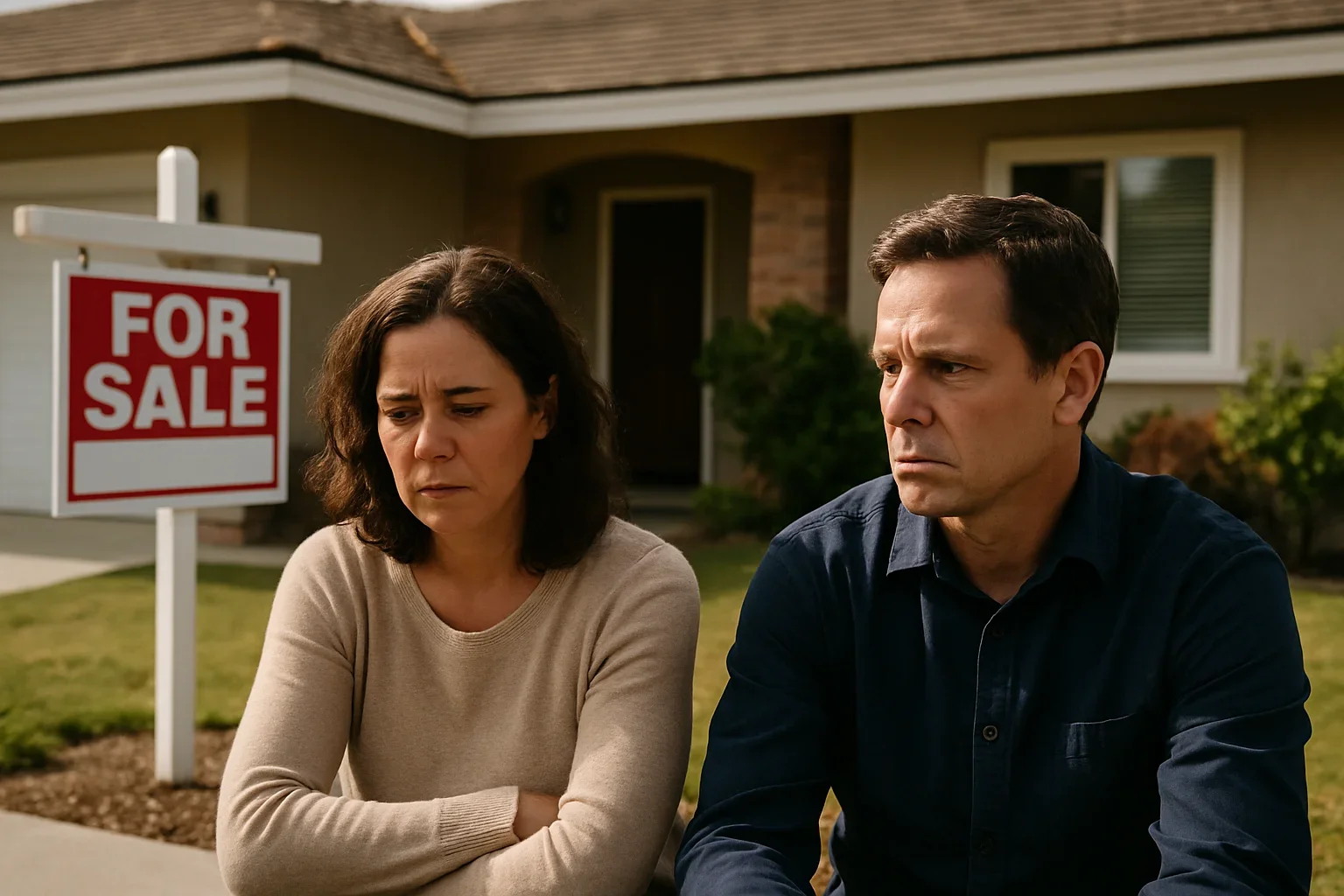
When you list a home through an agent, the sale becomes public. There is a FOR SALE sign in the yard. Neighbors see the showings. The transaction appears on the MLS. In a divorce, that visibility adds a layer of exposure at a time when many people are already feeling raw.
A cash sale is entirely private. No MLS listing. No open houses. No sign in the yard. Your neighbors, coworkers, and extended family do not need to know the details of what is happening unless you choose to tell them. The transaction processes through a licensed title company just like any traditional sale — but without the public-facing marketing that comes with a listing.
For families with children, this privacy often matters deeply. A clean, quiet sale lets the family control the narrative.
What If the House Needs Repairs You Cannot Afford Right Now?
Divorce is expensive. Attorney fees, a second household, court costs — money is tight for most families going through this process. The idea of also funding $20,000 in repairs to make the house "list-ready" is genuinely out of reach for many couples.
A cash buyer purchases the home as-is. No repairs required. No cleaning, no staging, no painting, no fixing the deferred maintenance that has accumulated. The condition of the house is factored into the offer, but neither party has to come out of pocket to prepare it for sale.
If you have been avoiding the house conversation because you know it needs work and neither of you can agree on who pays for what, a cash sale removes that entire argument from the equation. You get an offer based on the home in its current condition. That is all.
For more on what selling as-is looks like in practice, see selling a house as-is in California.
How Ummah Homes Works With Divorcing Couples in Sacramento
Ummah Homes has worked with many divorcing homeowners across the Sacramento region, including families in Elk Grove, Folsom, Citrus Heights, Rancho Cordova, and Roseville. The situation is familiar, and the process is designed to be as low-friction as possible for people who are already managing a lot.
Here is exactly how it works:
Step 1: One or both spouses fills out the form or calls
You do not need to have everything sorted out before reaching out. You just need to have the conversation. Tell us about the property — the location, condition, any outstanding liens you know of. This all happens over the phone. We do not visit the property before making an offer.
Step 2: We give you a cash offer on the call
Since COVID, Ummah Homes built a system that allows us to give accurate, firm cash offers without a preliminary walkthrough. We gather everything we need on the phone. Most sellers have a number within the same call or shortly after.
Step 3: Both spouses review the offer independently
You are not locked into anything. Either spouse can have their own attorney review the offer and the purchase agreement before signing. There is no pressure and no deadline. Take the time you need.
Step 4: Once both parties agree, we sign an agreement
At that point, we schedule a brief visit to confirm what was discussed on the phone. If everything matches, the price stays exactly the same. The only reason a price adjustment would ever come up is if there is something significant neither party was aware of — like a hidden structural issue.
Step 5: We close in 21-24 days — or on your timeline
If you need to close in 10 days because of a court date, we can do that. If you need 60 days because one spouse is still figuring out housing, we can do that too. The timeline works around your life, not ours.
Step 6: Funds are wired within 24-48 hours of closing
The title company — a neutral third party — handles all money and paperwork. Neither side touches the funds directly. Proceeds are split according to whatever agreement you and your spouse have reached, whether through attorneys, a divorce decree, or a mutual decision. The title company follows your written instructions.
If you are not ready to fill out a form yet but want to understand your options first, Ummah Homes has a local office in Sacramento where either spouse can come in, sit down, and ask questions without any obligation whatsoever.
You Can Leave Everything Behind
This one matters more than people expect. When you are going through a divorce and trying to separate two households, the last thing most people want to do is spend a weekend sorting through shared furniture, old appliances, and years of accumulated belongings.
With a cash sale, you take what matters to you. Leave the rest. Furniture, appliances, items you cannot agree on, things nobody wants — all of it can stay. Ummah Homes handles the cleanout after closing. You do not need to empty the house, stage it, or resolve every shared possession before selling.
That removes a significant logistical and emotional burden from an already hard process.
When You Are Ready to See What Your Home Could Sell For
If you have read this far, you are probably weighing your options seriously. That is exactly the right place to be. You do not need to have made a decision. You just need a number — a real, no-obligation cash offer that tells you what a clean, fast sale would look like.
If you are ready to explore that, the easiest first step is to sell my house fast in Sacramento and see what your home could sell for. It takes about two minutes to fill out the form, and there is no commitment involved.
"*" indicates required fields
What Happens After You Submit the Form
-
Within 24 hours, someone from Ummah Homes calls you to learn about the property. This is a simple conversation — address, condition, any details you know about. Both spouses can be on the call, or just one to start.
-
We present a cash offer over the phone. No visit required at this stage. The offer is based on what you share with us about the property.
-
You take time to review. Share the number with your spouse, your attorney, your family. No pressure to decide on the call.
-
If you want to move forward, we sign a purchase agreement. At that point, we schedule a brief property visit to confirm what was discussed. If everything matches, nothing changes.
-
Closing happens in 21-24 days — or on a date that works for your situation. Funds are wired by the title company within 24-48 hours of closing.
-
If the offer does not work for you, you say no. That is it. No awkward conversation, no pressure, no obligation. The offer is a starting point, not a contract. You are in control of this decision from beginning to end.
Frequently Asked Questions
Can I sell my house during a divorce without my spouse's consent in California?
No. Because California is a community property state, both spouses must sign to sell a home that was purchased during the marriage. If one spouse refuses, the other can file a partition action in court, but that process typically costs $5,000-$15,000 in legal fees and takes 6-18 months. A negotiated agreement — including a cash sale both parties accept — is almost always faster and less expensive.
How is the money split when selling a house in a California divorce?
In most cases, a 50/50 split applies to community property. However, the actual split can be adjusted by a divorce settlement agreement, prenuptial agreement, or court order. The title company follows whatever written instructions both parties provide at closing. Any outstanding mortgage, HELOC, or liens are paid off first from proceeds before the remaining balance is distributed.
Does selling a house during divorce affect capital gains taxes?
Potentially yes. Married couples filing jointly can exclude up to $500,000 in capital gains on a primary residence sale. If the home is sold after finalization of the divorce, each individual's exclusion drops to $250,000. Timing the sale relative to your divorce decree can have meaningful tax implications. Consult a CPA before closing.
What if we owe more on the house than it's worth?
If your combined mortgage and liens exceed the home's current market value, a traditional sale would require a short sale — meaning the lender must approve a sale for less than what is owed. This adds steps and timeline to the process. Ummah Homes has experience working through underwater mortgage situations. It is not a dealbreaker, but it does require lender involvement and clear communication upfront.
Can we sell the house before the divorce is finalized?
Yes. Many couples sell the marital home before their divorce is finalized, which can actually simplify the financial division process. The proceeds become cash assets that are easier to split than a physical property. Both spouses still need to sign, and the proceeds will be subject to the divorce proceedings. Your family law attorney can advise on the best timing for your specific situation.
How quickly can we close if we have a court deadline?
Ummah Homes can close in as few as 7-10 days if a court order or other deadline requires it. The standard timeline is 21-24 days, but we work around your schedule. If you have a specific date you need to meet, share that on the call and we will structure the closing accordingly.