
Selling a House With Fire or Water Damage: What Sacramento Homeowners Should Know
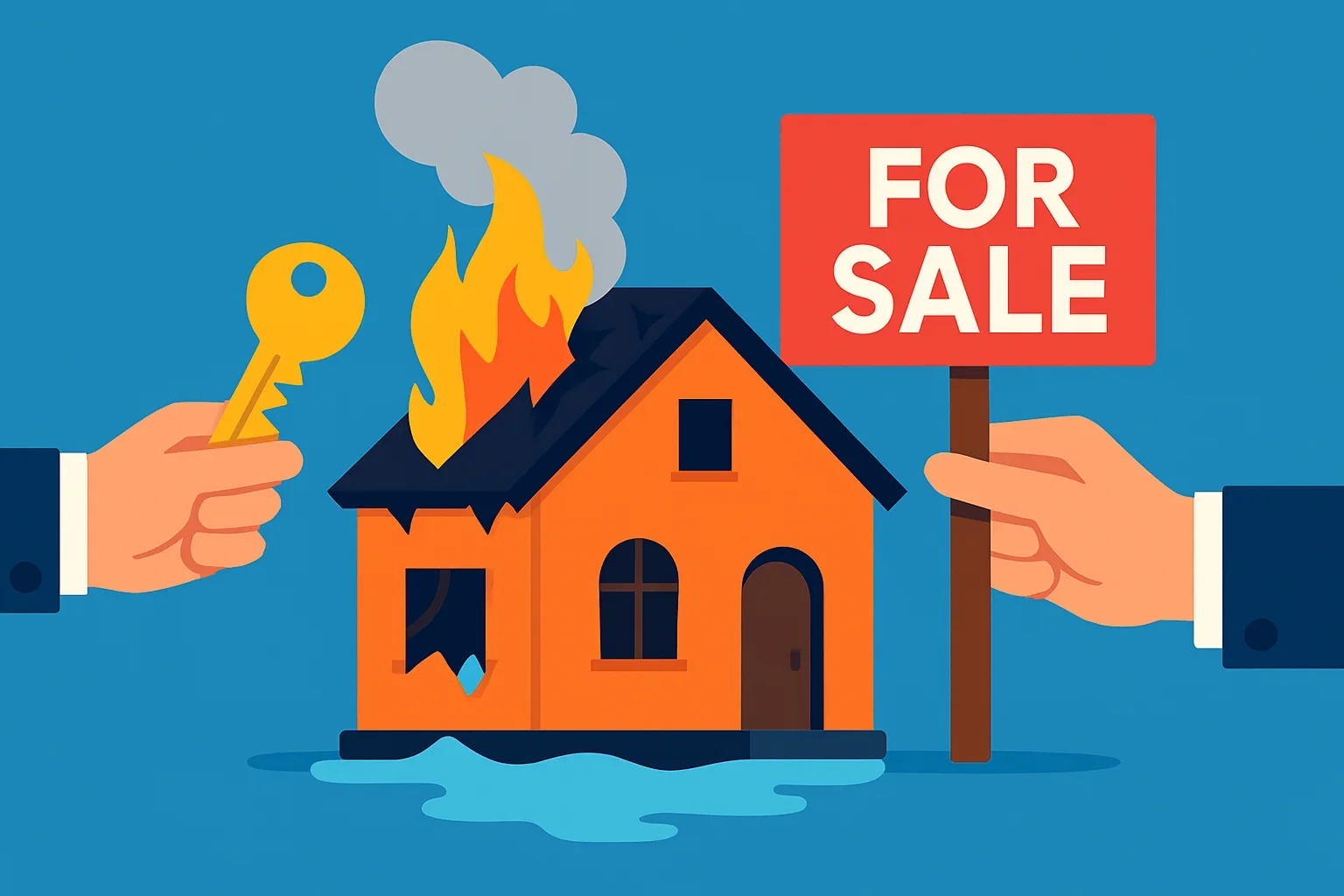
Sacramento homeowners can sell a fire or water damaged house without making a single repair — cash buyers purchase damaged properties as-is, closing in as few as 7 to 21 days. You are not required to restore the home before selling, and California law gives you a clear path to disclose damage honestly and move on. Whether the damage is partial or severe, you have real options beyond the repair-and-list route that most people assume is the only way.
The Weight of a Damaged House Feels Different Than Any Other Problem
There is a particular kind of grief that comes with standing in a home after a fire or flood. It is not just the smell of smoke or the sight of warped floors — it is the feeling that everything is now out of your control. The insurance company is sending adjusters. Contractors are quoting numbers that do not seem real. The mortgage is still due. And somewhere underneath all of it is a quiet, terrifying question: Can I even sell this thing?
If you are in that place right now, you are not failing. You are not alone. Every year, thousands of California homeowners face exactly this situation — and most of them did not see it coming either.
Some are dealing with a kitchen fire that charred the cabinets and ceiling but left the rest of the house intact. Others are looking at catastrophic damage from a burst pipe that went unnoticed for weeks while they were away, or a Sacramento area wildfire that came through the neighborhood and changed everything. The circumstances are different. The stress is the same.
The good news — and this is real, not the kind that gets walked back two paragraphs later — is that damaged houses are sold every day in Sacramento. You have more options than you think. This guide walks you through all of them, with honest numbers attached, so you can make a decision that works for your life.
What Fire and Water Damage Actually Costs to Fix (The Real Numbers)
Before you can evaluate your options, you need to understand what you are actually facing. Most homeowners either underestimate the damage or take a contractor's scariest quote at face value. Neither serves you well.
Fire damage restoration costs in California:
| Damage Level | Description | Estimated Repair Cost |
|---|---|---|
| Minor (smoke/soot only) | Cosmetic cleaning, repainting, odor treatment | $5,000 – $15,000 |
| Moderate (partial structure) | Drywall, flooring, fixtures, electrical | $20,000 – $60,000 |
| Severe (structural loss) | Framing, roof, HVAC, full systems rebuild | $80,000 – $200,000+ |
| Total loss | Rebuild from foundation | Land value + rebuild |
Water damage restoration costs in California:
| Damage Type | Description | Estimated Repair Cost |
|---|---|---|
| Clean water (burst pipe, appliance) | Dry-out, subfloor, drywall | $3,000 – $20,000 |
| Grey/black water (sewage, flooding) | Remediation, structural drying, rebuild | $15,000 – $75,000 |
| Mold present | Remediation alone before any repairs | $10,000 – $30,000+ |
| Foundation or crawl space | Structural waterproofing, vapor barrier | $10,000 – $50,000 |
Key takeaway: Even "minor" fire or water damage routinely costs $15,000 to $30,000 to repair to a standard that passes a traditional buyer's inspection. Moderate to severe damage can easily consume $50,000 to $100,000 or more — often more than insurance covers after deductibles, depreciation schedules, and coverage limits.
The gap between what insurance pays and what restoration actually costs is where homeowners get stuck. If your policy was not current, if your claim was partially denied, or if the damage falls under an exclusion, you may be looking at a repair bill you simply cannot fund.
That is not a character flaw. That is a financial reality. And it is exactly why the sell-as-is path exists.
California Disclosure Laws: What You Are Required to Tell Buyers
This is the question that keeps Sacramento homeowners up at night: If I sell, do I have to tell them what happened? What if they sue me later?
Here is the honest answer.
California requires sellers to complete a Transfer Disclosure Statement (TDS) in virtually every residential sale, including sales to cash buyers. The TDS requires you to disclose material facts you know about the property — including past fire damage, water intrusion, mold, and significant repairs.
The key word is know. You are not required to hire inspectors to discover problems before selling. You are required to disclose what you are already aware of. A buyer who later finds undisclosed damage they can prove you knew about has legal recourse. A buyer who discovers damage you genuinely did not know existed does not.
What this means practically:
- Disclose the fire or flood event, the extent of damage as you understand it, and any remediation or repairs made
- If insurance paid for partial repairs, disclose what was done and what was not
- If mold was found and treated, disclose it — even if treatment was complete
- If repairs were done without permits, disclose that too (more on this below)
Cash buyers expect disclosed damage. They are not surprised by it, and they do not use it to walk away the way financed buyers often do. A financed buyer's lender will flag fire or water damage on an appraisal or inspection and may refuse to fund the loan entirely. A cash buyer has no lender. The deal does not collapse because of what the inspector finds.
Honest disclosure protects you legally and sets realistic expectations upfront. It is not a liability — it is how you close cleanly.
The Insurance Question: What Happens When the Payout Is Not Enough
Insurance payouts for fire and water damage are almost never as straightforward as homeowners expect. California insurers use depreciation schedules, ACV (actual cash value) versus replacement cost calculations, and coverage caps that often leave a significant gap between what they pay and what restoration actually costs.
Common scenarios Sacramento homeowners face:
- Insurance covers 70% of restoration costs. The homeowner is expected to fund the remaining $30,000-$50,000 out of pocket. They cannot afford to.
- The claim is still open or disputed. The house cannot be financed by a traditional buyer's lender while there is an open insurance claim on the property.
- The policy lapsed. The home was unoccupied (inherited property, rental vacancy, snowbirding) and coverage lapsed without the owner realizing.
- The damage was excluded. Flood damage in a non-flood-zone policy. Mold after a slow leak that was considered "gradual damage."
If any of these situations apply to you, a traditional listing is often not viable. A cash sale, however, is. The insurance status of the property does not affect a cash buyer's ability to close.
If you have a pending insurance claim: You can still sell the property. The proceeds from the insurance claim may transfer to the buyer at closing, or you may negotiate to retain the claim. A real estate attorney can advise on the right structure. The point is — an open claim does not automatically block a sale.
Your Three Real Options After Fire or Water Damage
Most homeowners assume they have to restore the property before selling. That is the path most people picture, but it is not the only one — and for many Sacramento homeowners, it is not the smartest one either.
Option 1: Restore and List With an Agent
How it works: You fund or finance repairs, restore the property to market condition, hire an agent, and list on the MLS.
The upside: If the repairs are done well and the market is active, you may achieve close to full market value.
The real cost:
- Restoration: $20,000 – $100,000+ (your out-of-pocket, after insurance)
- Agent commission: 5–6% of sale price
- Holding costs during renovation and listing: $2,000–$4,000/month (mortgage, taxes, insurance)
- Buyer-requested repairs after inspection: $5,000–$15,000 additional
- Timeline: 4–8 months from decision to close
Who this works for: Homeowners with significant equity, access to capital, and the bandwidth to manage a renovation project from start to finish. If the damage is minor and the rest of the house is strong, this path can pencil out.
The problem: Most homeowners dealing with fire or water damage do not have $50,000 sitting in a checking account. And spending 4–8 months managing a renovation while continuing to pay the mortgage on a house you cannot live in is its own financial and emotional burden.
If you need to sell a house that needs major repairs in Sacramento, understanding the full scope of what restoration really costs — before committing to that path — is essential.
Option 2: List As-Is With an Agent
How it works: You list the property on the MLS in its current damaged condition, typically at a reduced price.
The upside: No repair costs. Exposure to the open market.
The reality: Most financed buyers cannot purchase a fire or water damaged home. Their lender will require the damage to be remediated before funding. This narrows your buyer pool dramatically to investors and cash buyers — the same buyers you could approach directly, without paying a 5–6% commission.
An as-is MLS listing also broadcasts your property's condition publicly. Open houses and listing photos showing damage can attract lowball investors while simultaneously stigmatizing the property for future traditional buyers if it sits.
Option 3: Sell Directly to a Cash Buyer
How it works: A local cash buyer evaluates the property, makes an offer based on current as-is condition, and closes without lender involvement or repair requirements.
The upside:
- No repairs, no staging, no cleaning
- No agent commissions (5–6% savings)
- No lender contingencies, inspection contingencies, or financing fallthrough
- Close in 7–21 days, or on your timeline
- Leave anything behind you do not want
The honest tradeoff: Cash offers are typically 70–85% of after-repair market value. The discount reflects the buyer absorbing the repair cost and risk. However, when you subtract the cost of repairs, agent commissions, holding costs, and the months of carrying a damaged home, many Sacramento sellers net more from a cash sale than from the restore-and-list route.
The math matters more than the headline number.
Side-by-Side: What Sacramento Sellers Actually Net
Here is a real-numbers comparison for a Sacramento home with an after-repair market value of $420,000 and $55,000 in fire damage:
| Restore + List | Sell As-Is (Cash Buyer) | |
|---|---|---|
| Market/offer value | $420,000 | $315,000 (75% of ARV) |
| Repairs out-of-pocket | -$55,000 | $0 |
| Agent commission (5.5%) | -$23,100 | $0 |
| Closing costs | -$4,200 | $0 |
| Holding costs (5 months) | -$14,000 | $0 |
| Staging/prep | -$4,000 | $0 |
| Buyer concessions | -$8,000 | $0 |
| Estimated net proceeds | $311,700 | $315,000 |
| Timeline | 6–8 months | 14–21 days |
| Risk of deal falling through | ~25% | Near zero |
The numbers often land within $10,000–$20,000 of each other — and the cash sale delivers that outcome in weeks, not months, with zero renovation risk.
For many Sacramento homeowners, especially those carrying the ongoing cost of a damaged, unlivable property, the certainty and speed of a cash sale makes it the financially superior choice. You can learn more about the real costs of selling your house in Sacramento — the hidden expenses that traditional listings rarely account for upfront.
The Mold Problem: Why Water Damage Is Often Worse Than It Looks
Mold is the hidden cost inside most water damage claims. What starts as a burst pipe or a roof leak can, within 24–72 hours, become active mold growth inside walls, under flooring, and in HVAC systems. By the time it is visible, it has often been growing for weeks.
According to the EPA, mold can begin to colonize wet building materials within 24 to 48 hours of water exposure.
Professional mold remediation in California costs $10,000 to $30,000 for moderate cases — and significantly more when it has reached structural framing, HVAC ducts, or crawl spaces. Traditional lenders will not fund a purchase on a property with active mold. That means any buyer relying on financing is effectively locked out of a mold-affected property until remediation is complete and certified.
Cash buyers price in mold remediation costs. If the seller discloses known mold, the offer reflects it — but the seller does not need to spend a dollar remediating before closing. The buyer takes on that responsibility. For a homeowner who cannot fund a $20,000 mold remediation out of pocket, this distinction is everything.
Unpermitted Repairs and Code Violations After Damage
After a fire or flood, homeowners sometimes make emergency repairs themselves or hire contractors who do not pull permits. The roof gets patched. Drywall goes up. Electrical gets re-run by someone who "knows what they're doing."
This is understandable. It is also a problem when it comes time to sell.
In California, unpermitted work must be disclosed. Traditional buyers' lenders will often flag it. City inspectors can require retroactive permitting or even demolition of non-compliant work. The process of legalizing unpermitted repairs can be expensive, time-consuming, and uncertain.
Cash buyers purchase properties with unpermitted work as-is. They factor the code compliance risk into their offer and handle the permitting process after closing. If your post-damage repairs were done without permits — or if you are simply not sure — that does not block a cash sale. You disclose what you know, and the buyer proceeds with their eyes open.
For a deeper look at this issue, selling a house with code violations in California covers the specific disclosure requirements and what sellers can expect from inspectors and buyers.

What If the Property Is a Rental?
Fire and water damage on a rental property adds another layer. If tenants were displaced, you may have temporary housing obligations under California law. If tenants remain in a partially damaged unit, habitability requirements apply. If the property has been vacant since the damage, you may be losing rental income while carrying full ownership costs.
Some landlords in this situation decide that the right move is simply to exit. Not every damaged rental is worth restoring — especially if the pre-damage returns were marginal, the tenant situation was already complicated, or the property requires more management than it is worth.
If that resonates, selling an unwanted rental property covers what landlords need to think through before deciding, including the tax and depreciation implications of a sale.
How a Cash Buyer Calculates an Offer on a Damaged Property
Understanding how cash offers are built removes the mystery — and the suspicion that you are being lowballed.
A legitimate cash buyer uses a straightforward formula:
Offer = After-Repair Value (ARV) − Estimated Repair Costs − Buyer's Margin
- ARV is what the home would sell for fully restored in today's Sacramento market
- Repair costs are estimated based on what the seller shares about the damage (condition, scope, known issues)
- Buyer's margin accounts for the risk of carrying the property, funding renovations, and eventual resale
The offer is not arbitrary. It is math. And because Ummah Homes handles everything over the phone first — gathering what they need about the property's condition, damage scope, and layout before ever visiting — the process is faster and less intrusive than most sellers expect.
The visit happens after the seller accepts the offer and an agreement is signed. At that point, the visit is simply to confirm what was described. If everything matches, the price stays the same. The only time an offer adjusts is when something materially different is discovered — a structural issue behind the drywall that was not visible or a roof problem that was not apparent from the outside.
No games. No bait-and-switch. If something comes up, it gets explained clearly and the seller decides how they want to proceed.
What About My Existing Mortgage?
Many homeowners assume they need to pay off their mortgage before selling a damaged house. They do not.
Your mortgage gets paid off at closing through the title company, directly from the sale proceeds. You do not need to bring funds to closing, arrange a payoff in advance, or contact your lender before accepting a cash offer. The title company handles all of it — the lender receives their payoff, any remaining liens are cleared, and the net proceeds go to the seller.
This is how every real estate transaction works, whether traditional or cash. You do not write a check. The title company wires the payoff on your behalf.
Ready to Explore Your Options? Here Is What the Next Step Looks Like
If you have read this far, you are probably weighing whether a cash offer makes sense for your situation. The easiest way to find out is simply to get the number — with no obligation attached to it.
Ummah Homes has worked with Sacramento homeowners dealing with fire damage, flood damage, mold, unpermitted repairs, and everything in between. There is no judgment about the condition of the house. There is no requirement to clean, stage, or apologize for what you are dealing with.
The conversation starts on the phone. Tell us about the property — what happened, what the damage looks like, where things stand with insurance. We use that information to put together a real cash offer. No in-person visit required upfront, no one walking through your home before you have a number in hand.
If you want to sell my house fast in Sacramento — without the months of renovation, the listing process, and the uncertainty — fill out the form below and we will be in touch within 24 hours.
"*" indicates required fields
What Happens After You Reach Out
Here is exactly what the process looks like, step by step:
- You call or submit the form. We reach out within 24 hours to learn about your property — the damage, the layout, what you know about the condition. Everything happens over the phone.
- We present a cash offer on the call. No obligation, no pressure. The number is yours to think about. You can say no. You can get other offers and compare. We encourage it.
- If the offer works for you, we sign an agreement. After that, we schedule a brief visit to confirm the property details. If everything matches what you described, the price stays the same.
- You choose your closing date. Average closing is 21–24 days, but if you need 7 days or 60 days, we work on your timeline.
- Funds are wired within 24–48 hours of closing. A neutral title company handles all the money and paperwork. Neither side touches the funds directly — the same protection used in any California real estate transaction.
You can leave behind anything you do not want. Furniture, debris, personal items left by tenants — all of it. We handle the cleanout after closing. You pack what matters and walk away from the rest.
If you would feel more comfortable meeting in person before deciding anything, Ummah Homes has a local office. That option is always available.
Frequently Asked Questions
Can you sell a fire damaged house in California without repairing it first?
Yes. California law does not require sellers to repair damage before selling. You must disclose known damage on the Transfer Disclosure Statement, but the sale itself can proceed as-is. Cash buyers purchase fire and water damaged homes regularly and do not require repairs as a condition of the offer.
Do I have to disclose fire or water damage when selling in California?
Yes. California's Transfer Disclosure Statement requires you to disclose material facts you are aware of, including past fire damage, water intrusion, mold, and unpermitted repairs. You are only liable for what you knowingly concealed — not for damage you were unaware of. Honest disclosure protects you legally and helps transactions close cleanly.
How much will a cash buyer offer for a fire damaged house?
Cash offers on damaged properties typically range from 60–80% of after-repair market value, depending on the severity of damage and current Sacramento market conditions. The offer reflects the buyer absorbing full repair costs and risk. When sellers subtract what they would have spent on repairs, commissions, and holding costs, the net difference from a traditional sale is often smaller than expected.
Can I sell my house if there is an open insurance claim?
Yes. An open insurance claim does not prevent a sale, though it adds complexity. Depending on the structure of the transaction, the insurance proceeds may transfer to the buyer or stay with the seller. A real estate attorney can advise on the best approach for your situation. Cash buyers can close regardless of the insurance claim status.
How long does it take to sell a fire or water damaged house for cash?
A cash sale on a damaged property can close in as few as 7 days and typically completes within 14–21 days. Compare that to 4–8 months for the restore-and-list route (including renovation time and days on market). For sellers carrying ongoing mortgage, insurance, and maintenance costs on a property they cannot live in, speed has real dollar value.
What if the damage was made worse by unpermitted repairs?
Unpermitted repairs must be disclosed in California, but they do not block a cash sale. Cash buyers factor code compliance into their offer and handle permitting after closing. You do not need to retroactively legalize any work or tear anything down before selling.
Related Articles
- Selling a House As-Is: What You Need to Know
- The Real Costs of Selling Your House in Sacramento
- Selling Your Rental Property As-Is: What Landlords in Sacramento Need to Know
- Selling an Inherited House: What Sacramento Families Should Know
- Selling a House During Divorce in California: What Both Spouses Need to Know